
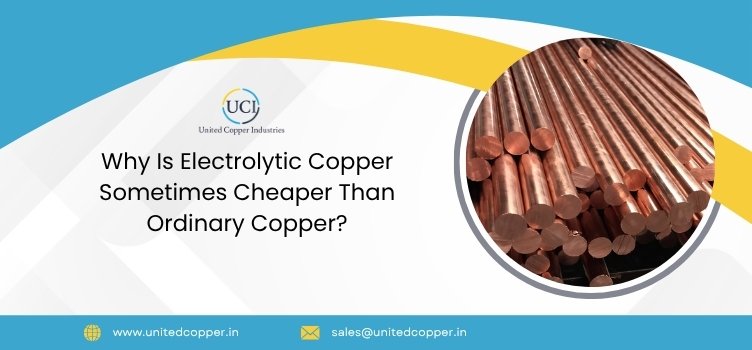
Understanding the Price Paradox in Copper Markets
Electrolytic Copper Sometimes Cheaper Than Ordinary Copper. At first glance, this sounds counterintuitive. In its turn, electric copper is reportedly of high purity (typically 99.9% or higher), although ordinary copper may include more impurities. And then why not choose a more developed product?
This can be resolved in the production of copper, trading and classification of copper in the world copper market. Such variables on the fluctuation of the prices include the productivity of the supply chain, production processes, demand trends and copper grades. The article disaggregates the key factors that cause such pricing phenomenon in order to make informed decision-making in sourcing of copper materials to enable mechanical engineers, procurement experts and industry experts to make informed decisions.
Electrolytic Copper vs Ordinary Copper: What’s the Difference?
Understanding the distinction between electrolytic copper vs ordinary copper is essential.
Electrolytic Copper:
- Ready-made through electrorefining or electrowinning.
- High purity (≥99.9%)
- It has uses in electrical, electronics and precision industries.
Ordinary Copper:
- Copper of low grade or raw copper.
- It is the month of May, which is unclean or unholy.
- Graphical work, plumbing and general metal work in the building generally.
The copper that is derived through the electrolytic process is purer, and it can be marketed at a lower price based on the market forces that are in existence at that specific time, as opposed to the value of the material.
Key Reasons Why Electrolytic Copper Can Be Cheaper
1. Large-Scale Industrial Production Efficiency
Automated refineries usually produce electrolytic copper on a large scale. These facilities enjoy the advantages of:
- Economies of scale
- Continuous production processes
- Decreased unit labour costs.
This reduces the price per ton, and the electrolytic copper is relatively inexpensive compared to the small-scale production of ordinary copper.
2. Standardization in Copper Grades
The uniform copper grades that are likely to be typical, such as LME Grade A, tend to be under the category of electrolytic copper grades. This standardization:
- Simplifies global trading
- Minimizes the costs of certification and tests.
- Improves the liquidity in the copper market.
Average copper can also need more inspection and grading, and therefore it is more expensive.
3. Supply and Demand Imbalance
The copper market is very elastic to the changes in supply and demand.
- High supply of the electrolytic copper by the big players may pressurize the price downwards.
- They are even more costly due to the fact that certain of their typical copper materials (e.g. scrap or speciality alloys) are not accessible.
Even pure copper is lower than in such cases where there is saturation in the market.
4. Recycling and Scrap Market Influence
Ordinary copper is normally combined with recycled or scrap material. Even though recycling is cheap, it involves:
- Separating and isolating expenses.
- Quality inconsistencies
- Handling and transportation expenses.
These occasionally lead to the high cost of making the normal copper more costly than freshly refined electrolytic copper.
5. Logistics and Regional Pricing Differences
Copper pricing is also dependent on the region as a result of:
- Import/export duties
- Transportation costs
- Local demand
The copper electrolytic is a standardised and traded product, and as such it is likely to undergo an optimized logistics network that would lead to a reduced cost delivered.
Comparison Table: Electrolytic Copper vs Ordinary Copper
| Parameter | Electrolytic Copper | Ordinary Copper |
|---|---|---|
| Purity Level | ≥99.9% | 85%–99% (varies) |
| Production Method | Electrorefining/Electrowinning | Smelting/Secondary refining |
| Cost Stability | More stable (market-linked) | Variable |
| Application | Electrical, electronics | Plumbing, construction |
| Quality Consistency | High | Moderate |
| Market Availability | High (global standard) | Region-specific |
Impact of Copper Price Trends on Buyers
The copper price trends must be known amongst the procurement experts or engineers:
- The electrolytic copper would be on a large scale, which would be cheaper to utilize.
- Other mechanical or construction uses of copper can still be sought, even of ordinary copper.
- Comparison of price differences must always be done based on application requirements.
When making the appropriate selection of material, the trade-off between performance, availability and cost is experienced.
Conclusion
Although it is unexpected, Electrolytic Copper Sometimes Cheaper Than Ordinary Copper because of such factors as mass production, standard copper grade, and world supply forces. The copper market is complicated, and prices are not only based on purity but also on logistics, demand cycles and processing costs.
In the case of industrial use, the knowledge of these subtleties can be used to make the process of selecting materials cost-effective and efficient. Regardless of whether you are designing piping systems or handling procurement, it is important to assess the two types of copper, the electrolytic and the ordinary, depending on the application and the market conditions.
FAQs
Q1. Why is electrolytic copper considered high quality?
The purification of the electrolytic copper is then conducted to more than 99.9 through the use of an electrochemical process that renders it exquisite in electrical and accuracy applications.
2. Is ordinary copper less reliable than electrolytic copper?
Not necessarily. The majority of the works that touched on plumbing and construction could be done with simple copper, and not as homogeneous as the electrolytic copper.
3. How does the copper market affect pricing?
The international market of copper, its supply, mining production and the cost-effective nature of the same could influence the adjusted price of the different grades of copper.
Looking for high-quality electrolytic copper or reliable ordinary copper for your industrial needs? Connect with our experts today for competitive pricing, technical guidance, and customized solutions. Contact us now or email us at sales@unitedcopper.in to request a quote!