
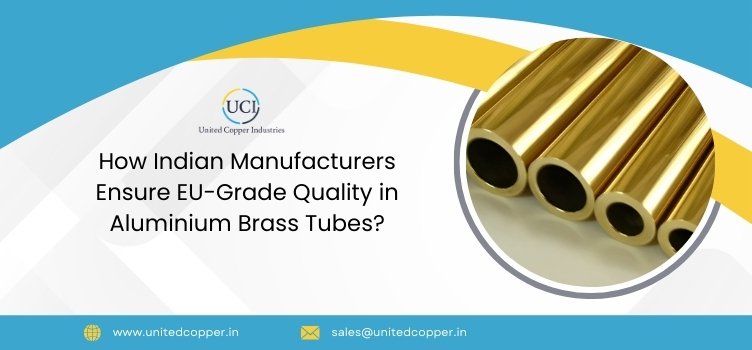
Meeting Global Engineering Standards Through Advanced Manufacturing
The industries that require materials for global infrastructure, marine engineering, and heat exchangers are very strict regarding international standards. It is here that EU-Grade Quality in Aluminium Brass Tubes comes in. Shipbuilding, power generation, and industrial construction European projects demand tubes with high levels of corrosion resistance, long life, and an extremely specific metallurgical composition.
In the last 20 years, India has proved to be a reliable source of high-performance metal parts. Most exporters have developed EU-standard aluminium brass tubes, designed to meet international requirements, such as aluminium brass tubes ASTM B111 C68700, to be reliable for use in harsh environments. Indian manufacturers have achieved recognition in European markets through the use of well-developed testing processes, rigid process control, and compliance with the quality standards for aluminium brass tubes exported to European markets.
For construction heads, architects, contractors, and industrial procurement teams, knowledge of how Indian manufacturers ensure EU quality standards will give them a sense of security when procuring materials for mega infrastructure projects. Indian Capabilities in manufacturing, with well-developed manufacturing clusters and export hubs, have made the country a global supplier of precision brass tubing.
EU Standard Aluminium Brass Tubes: Understanding the Technical Requirements
European consumers insist on adherence to international materials standards. The EU standard aluminium brass tubes are used in high-performance applications such as condensers, heat exchangers, and desalination plants.
Key technical requirements include:
- Regulated chemical composition, including corrosion-resistant aluminium additions.
- High pressure and temperature require mechanical strength.
- Accuracy of dimension tolerance.
- Good resistance to seawater corrosion.
They are usually made from ASTM B111 C68700 aluminium-brass tubes, which are a fairly popular specification in Europe for manufacturing condenser and heat exchanger tubing.
To ensure that the product has EU-Grade Quality in Aluminium Brass Tubes, manufacturers need to be consistent across production batches, which requires high-level metallurgical skills and rigorous scrutiny procedures.
Aluminium Brass Tubes ASTM B111 C68700 and Their Industrial Importance
One of the most commonly used brass tubing grades exported to India is the alloy grade silver aluminium brass tube ASTM B111 C68700. It contains copper, zinc, and aluminium, which are more resistant to corrosion from seawater and industrial fluids.
Industries that have a dependency on this grade are:
- Shipbuilding and marine engineering.
- Power plant heat exchangers.
- Oil and gas processing units.
- Industrial cooling systems.
High demand for this alloy in Europe has influenced the thinking of Indian manufacturers, who are setting strict production measures to meet the quality standards for aluminium brass tubes for export.
Key performance benefits include:
- Very high anti-fouling characteristic.
- Prolonged working life in the Marines.
- Good thermal conductivity.
- Fewer maintenance requirements of condenser systems.
These merits have made the alloy suitable for critical infrastructure in the industry.
How Indian Manufacturers Ensure EU Quality Standards?
The strict quality systems enforced in the industry have been a key factor in making India a global supplier of brass tubes. Major exporters allocate a lot of resources towards technology, testing machines, and compliance systems.
Indian manufacturers put in place some crucial means by which they guarantee the EU quality standards, and they include:
1. Advanced Metallurgical Testing
Manufacturers perform various tests to retain the same composition and mechanical strength.
Common tests include:
- The analysis of chemical composition.
- Eddy current testing.
- Hydrostatic pressure stress testing.
- Ultrasonic inspection.
These are processes that guarantee EU-Grade Quality in Aluminium Brass Tubes used in European engineering works.
2. Precision Manufacturing Processes
Extrusion and drawing devices in modern facilities use automated systems to ensure that the extrusion and drawing of walls and interiors are performed with high consistency and cleanliness.
Benefits of precision manufacturing:
- Enhanced effect on fluid flow.
- Reduced corrosion points.
- Increased structural stability.
3. Compliance with International Certifications
Export-oriented manufacturers are certified by the worldwide standards, such as:
- Availability of the ISO quality management systems.
- ASTM material compliance.
- Acceptance of Third-party inspection.
These qualifications are used to support the quality requirements for aluminium brass tubes to be exported to European consumers.
Indian Capabilities in Manufacturing Aluminium Brass Tubes
India has also established an internationally competitive infrastructure in the metallurgy sector to facilitate exports. It has generated massive quantities of EU-standard aluminium-brass tubes whilst maintaining high standards of quality control in the country.
Major strengths of Indian Capabilities in Manufacturing include:
- State-of-the-art copper alloy production plants.
- Proficient metallurgical engineers.
- Costs of production are competitive.
- International transport and export systems.
International inspection agencies usually team up with Indian producers to check compliance prior to delivery. This also guarantees that customers receive quality, uninterrupted materials.
Why Mumbai Leads India’s Brass Tube Exports?
The brass tube industry in India is concentrated in a few industrial areas, although Mumbai leads India’s brass tube exports, largely due to its strategic location.
Mumbai offers:
- Close to key ports towards international exports.
- Powerful supply chain of copper and alloy materials.
- Existence of skilled engineering producers.
- International shipping accessibility.
Mumbai has many major exporters who produce EU-Grade Quality Aluminium Brass Tubes within the city and its surrounding industrial areas, which have become major hubs for supplying the product to European markets.
Aluminium Brass Tubes Export Quality Standards for Global Projects
Indian manufacturers also conform to stringent standards for aluminium-brass tubes, exporting quality to compete with the world. These standards ensure tubes are reliable in challenging engineering applications.
Typical export requirements include:
- Adherence to ASTM B111 C68700 standards.
- Pre shipment inspection by a third party.
- Detailed certificates of material test.
- Dimensional and mechanical test.
These measures will enable Indian exporters to supply EU-standard aluminium-brass tubes consistently for infrastructure projects worldwide.
Conclusion
To sum up, India has proven itself to be a manufacturer of EU-Grade Quality in Aluminium Brass Tubes through a combination of high-quality manufacturing processes, stringent quality assurance, and internationally accepted certifications. Manufacturers can meet European requirements by manufacturing aluminium brass tubes ASTM B111 C68700, ensuring high-quality products for export.
Also, powerful Indian manufacturing and export centers, such as Mumbai, have helped make the nation a leading global provider. For construction leaders, architects, and industrial contractors, sourcing aluminium brass tubes in India offers reliability in terms of technical aspects and a cost-effective remedy for large infrastructure and engineering projects.
FAQs
Q1. Are aluminium brass tubes ASTM B111 C68700 suitable for marine applications?
Yes. Aluminium brass tube ASTM B111 C68700 is very common in marine settings due to its superb seawater corrosion resistance, biofouling resistance, and pressure resistance.
Q2. How do Indian manufacturers ensure EU quality standards in brass tubes?
Manufacturers in India guarantee compliance with EU standards by using modern metallurgical trials, monitoring the process, and adhering to ASTM requirements, as well as obtaining third-party certification of the product before sending it overseas.
Q3. Why are EU-standard aluminium-brass tubes preferred in heat exchangers?
EU standard aluminium-brass tubes are chosen because they offer superior thermal conductivity, corrosion resistance, and service life in reaction condenser and heat exchanger systems.
Looking for EU-Grade Quality in Aluminium Brass Tubes for your next infrastructure or industrial project? Connect with a trusted Indian manufacturer today to source high-performance export-grade brass tubes. Contact our team to discuss your requirements or email us at sales@unitedcopper.in for expert assistance.