
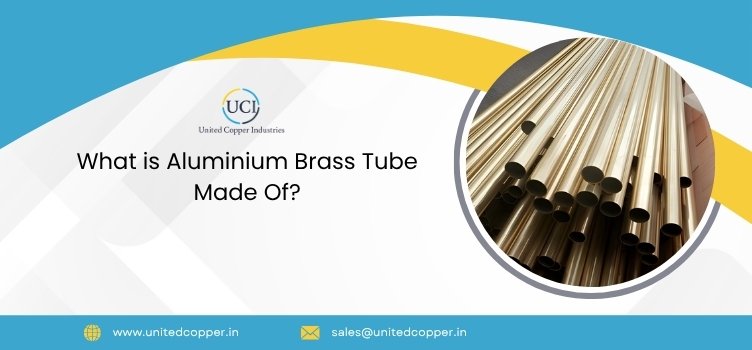
Understanding the Composition and Importance of Aluminium Brass Tubes
Industries that use aluminium brass tubes are common in places where resistance to corrosion, durability and thermal efficiency are paramount. These specialized tubes are mainly used in special applications that require robust settings like marine, power generation and heat exchanger systems. But what is actually in their preparation?
This article will decompose the structure of aluminium brass tubes, discuss their production, and mention their most important uses. Whether you are an auto engineer, metallurgist, or even a procurement expert, you may use the material science of these tubes to make a wise choice in terms of performance-critical applications.
What Are Aluminium Brass Tubes Made Of?
Aluminium brass is a personification of copper alloys mixed with zinc and a slight amount of aluminium. Their structure is well-designed to enhance their strength and resistance to corrosion.
Typical Chemical Composition:
- Copper (Cu): 76%-79%
- Zinc (Zn): 20%-22%
- Aluminium (Al): 1.8%-2.5%
- Other trace elements, such as iron, manganese or arsenic (to enhance properties)
Why Add Aluminium?
The introduction of aluminium is a very important factor:
- Coats the surface with an oxidizing station.
- Increases the seawater corrosion resistance.
- Strengthens and increases the life of the apparatus.
Manufacturing Process of Aluminium Brass Tubes
The manufacturing process of aluminium Brass Tubes is a complex process with many steps of precaution to achieve quality and consistency.
Key Steps:
1. Melting and Alloying
- The raw materials (copper, zinc, and aluminium) are melted under regulated furnaces.
2. Casting
- The molten alloy is cast into billets or hollow shapes.
3. Hot Extrusion
- The billet is forced into a high-temperature tube shape.
4. Cold Drawing
- Tubes are pulled through dies in order to get proper dimensions and a smooth finish.
5. Annealing
- Heat treatment enhances ductile and it alleviates internal stress.
6. Testing and Finishing
Includes:
- Eddy current testing.
- Hydrostatic pressure testing.
- Surface polishing.
Indian manufacturers adopt advanced technology, stringent quality control measures, and compliance with international standards to ensure their aluminium brass tubes meet EU-grade quality requirements.
Key Properties of Aluminium Brass Tubes
A combination of mechanical and chemical properties provides a balanced combination of aluminium and brass:
- Outstanding resistance to corrosion, particularly in the sea.
- Very high thermal conductivity and are therefore best in heat exchangers.
- Good strength and ductility.
- Antibiotic resistance to biofouling and scaling.
- Extended maintenance-free life.
Applications of Aluminum Brass Tubes
The uses of aluminium brass tubes cut across the various industries because they perform well.
Common Uses:
- Condensers and heat exchangers.
- Desalination plants.
- Marine engineering systems.
- Energy facilities (cooling systems).
- Oil and gas processing units.
Why They’re Preferred:
- Can withstand pressure conditions.
- Desalination in saltwater.
- Have cost-effective long-term durability.
Aluminium Brass vs Standard Brass: Property Comparison
| Property | Aluminum Brass Tubes | Standard Brass |
|---|---|---|
| Corrosion Resistance | Excellent (marine-grade) | Moderate |
| Strength | Higher | Moderate |
| Thermal Conductivity | High | High |
| Resistance to Biofouling | Strong | Weak |
| Lifespan | Longer in harsh conditions | Shorter |
Why Aluminum Brass Tubes Matter in Industrial Applications?
In the case of industries such as automotive manufacturing and thermal systems, the choice of materials has a direct influence on efficiency and durability. Distribution tubes made of aluminium brass offer:
- Reduced maintenance costs.
- Better operational efficiency.
- Improved security in hostile conditions.
They are highly reliable even in corrosive environments, making them the favored engines and procurement choices in the global market.
Conclusion
Aluminium brass tubes are designed alloys, which are mainly composed of copper, zinc, and aluminium to provide amazing performance in corrosion and thermal qualities. These tubes are constructed to be durable and efficient in terms of their well-crafted composition and high-tech production line.
They have diverse applications in industrial heat exchangers and marine systems, which show their significance in contemporary engineering. As a professional in search of long-lasting and high-performance material, aluminium brass tubes prove to be a convenient and efficient offer.
FAQs
Q1. What makes aluminium brass tubes corrosion-resistant?
The aluminium is contained in the form of a thin layer of protective oxide on the surface that serves to inhibit corrosion, particularly in seawater.
Q2. Where are aluminium brass tubes commonly used?
They are also extensively applied in heat exchangers, condensers, desalination plants and marine systems because they are durable and can endure harsh environments.
Q3. Are aluminium brass tubes better than regular brass tubes?
Indeed, aluminium brass tubes are more resistant to corrosion, have increased life and perform at higher rates in demanding conditions than do ordinary brass.
If you’re sourcing reliable aluminium brass tubes for industrial or automotive applications, we can help. Get in touch today for customized solutions, competitive pricing, and expert support. Contact us now or email us at sales@unitedcopper.in to request a quote.